Your Relationship After having a Baby: Communication and Mental Load
Why relationships change after a baby, what the “mental load” really is, and simple ways to stay connected and communicate better as new parents.
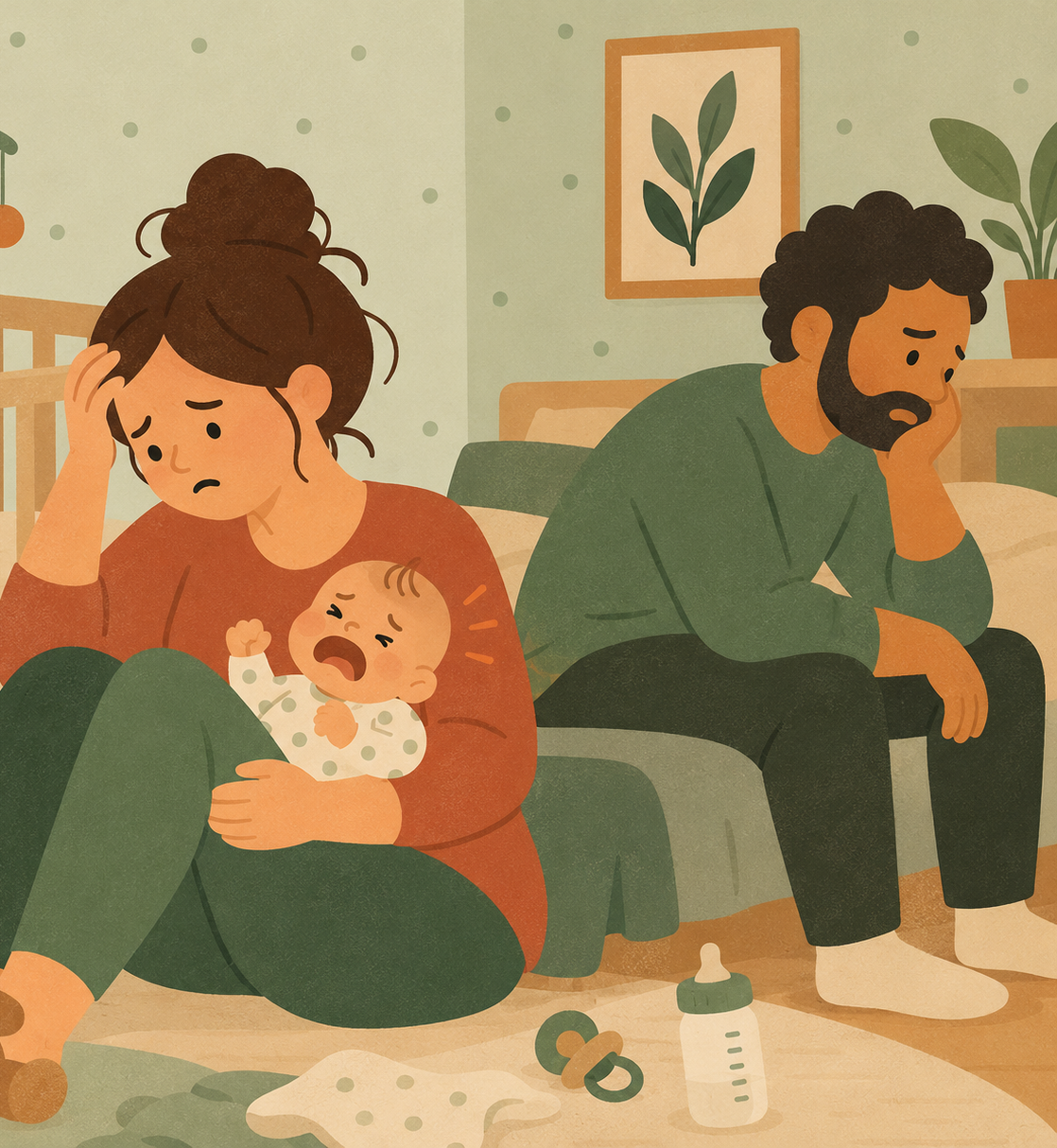
Becoming parents changes the couple, not just the family. More frequent arguments, feeling alone even as a pair, a mental tally of who does what that never quite adds up: these are common signs, not a failure or an exception. On this page, discover why this happens, what the research says about the so-called “mental load,” and which concrete practices genuinely help you communicate better in the early months — with a specialist's support when you need it.
Why relationships change after a baby
A decline in relationship satisfaction after a first child is one of the most consistent findings in relationship research: a recent meta-analysis of over 145,000 people confirms a significant decline from pregnancy to twelve months postpartum, for both parents (1). An eight-year prospective study found that 90% of couples studied experienced a decline in marital satisfaction after the birth of their first child, though the intensity ranged from mild to more pronounced depending on the couple (2). This isn't a sign that something is wrong with the relationship — it's an expected transition, made more intense by very concrete factors like sleep deprivation, an identity shift, and a full reorganisation of time, not by a pre-existing relationship problem.
What the research says
One of the best-documented drivers of this decline isn't tiredness itself, but the uneven distribution of what researchers call “cognitive labor” or mental load: anticipating, deciding, and monitoring a family's needs. A study of couples who described their division of labor as egalitarian found that even when practical tasks were split evenly, the work of anticipating and monitoring still fell almost entirely to one partner, usually the mother (3) with direct consequences for stress, burnout, and relationship satisfaction (4). The good news is the decline is neither automatic nor irreversible: a randomized study following couples from pregnancy through the baby's first year found that a targeted intervention on couple communication improved relationship quality and reduced post partum depressive symptoms in both parents, compared with a control group (5).
The mental load: what it actually is, and why splitting chores isn't enough
The mental load isn't the to-do list — it's the invisiblework that happens before and around that list: noticing the nappies are runninglow, remembering the paediatrician appointment, deciding which nursery tovisit, keeping track of who needs what and when. That's why “splitting thechores” doesn't automatically fix the imbalance: you can take turns cooking andstill be the only one who notices the fridge is empty. The mental load becomesa source of conflict precisely because it's hard to see — hard for the personcarrying it to name, and hard for the other parent to recognise unless it'smade explicit.
Building better communicationinto everyday life
You don't need a radical fix to start turning things around — small, consistent habits, repeated regularly, do most of the work.
- A short, regular check-in — ten distraction-free minutes a week to say how thingsare going — what's weighed heaviest, what's worked — is often enough to stoptension from building up silently.
- Divide the thinking, not just the doing — instead of asking “who does what,” ask “who keeps trackof what”: who holds the paediatrician deadlines in mind, who notices whensomething's running out. Naming it is the first step to actually redistributingit.
- Protect time as a couple, even briefly — you don't need a night out — fifteen minutes a day without the baby at the centre of the conversation is enough to stay a couple, not just a parenting team.
Why work with a specialist
Every couple moves through this phase differently: a couples therapist or family counsellor can help you name imbalances before they turn into resentment, offer concrete communication tools, and give you a protected space to talk it through without it becoming yet another argument.
References
1. Bogdan I, et al. Transition to Parenthood and Marital Satisfaction: A Meta-Analysis. Front Psychol.2022;13:901362.
2. BD, Rhoades GK, Stanley SM,Markman HJ., The Effect of the Transition to Parenthood on Relationship Quality: An 8-Year Prospective Study. J Pers Soc Psychol. 2009;96(3):601–619.
3. Daminger A., The CognitiveDimension of Household Labor. Am Sociol Rev. 2019;84(4):609–633.
4. Ciciolla L, Luthar SS., Invisible Household Labor and Ramifications for Adjustment: Mothers as Captains of Households. Sex Roles. 2019;81:467–486.
5. Shapiro AF, Gottman JM., Effects on Marriage of a Psycho-Communicative-Educational Intervention With Couples Undergoing the Transition to Parenthood, Evaluation at 1-Year Post Intervention. J Fam Commun. 2005;5(1):1–24.
need more personalized Support?
A professional can be by your side step by step, with the support and understanding you need.

Frequently Asked Questions
Yes: research shows a decline in relationship satisfaction affects the majority of couples in the first year after birth. It doesn't mean the relationship is at risk — it means it's going through a reorganisation that's worth addressing actively (1, 2).
It's the invisible work of anticipating, deciding, and monitoring a family's needs — not the tasks themselves, but the constant thinking behind them. Research shows it tends to stay unevenly distributed even when practical chores are split evenly (3,4)
Often not: you can alternate on practical tasks and still be the only one who remembers them, plans them, or notices when something needs attention. What also needs to be made explicit is who “keeps track,” not just who executes.
Couples who maintain relationship quality after a baby aren't the ones without difficulties — they're the ones who build small, regular check-in rituals. A randomised intervention built on exactly this principle showed measurable improvements in relationship quality at one year postpartum (5).
EXPLORE THE SPECIALISTS
No matches found. Please try again.
Explore the other blog posts