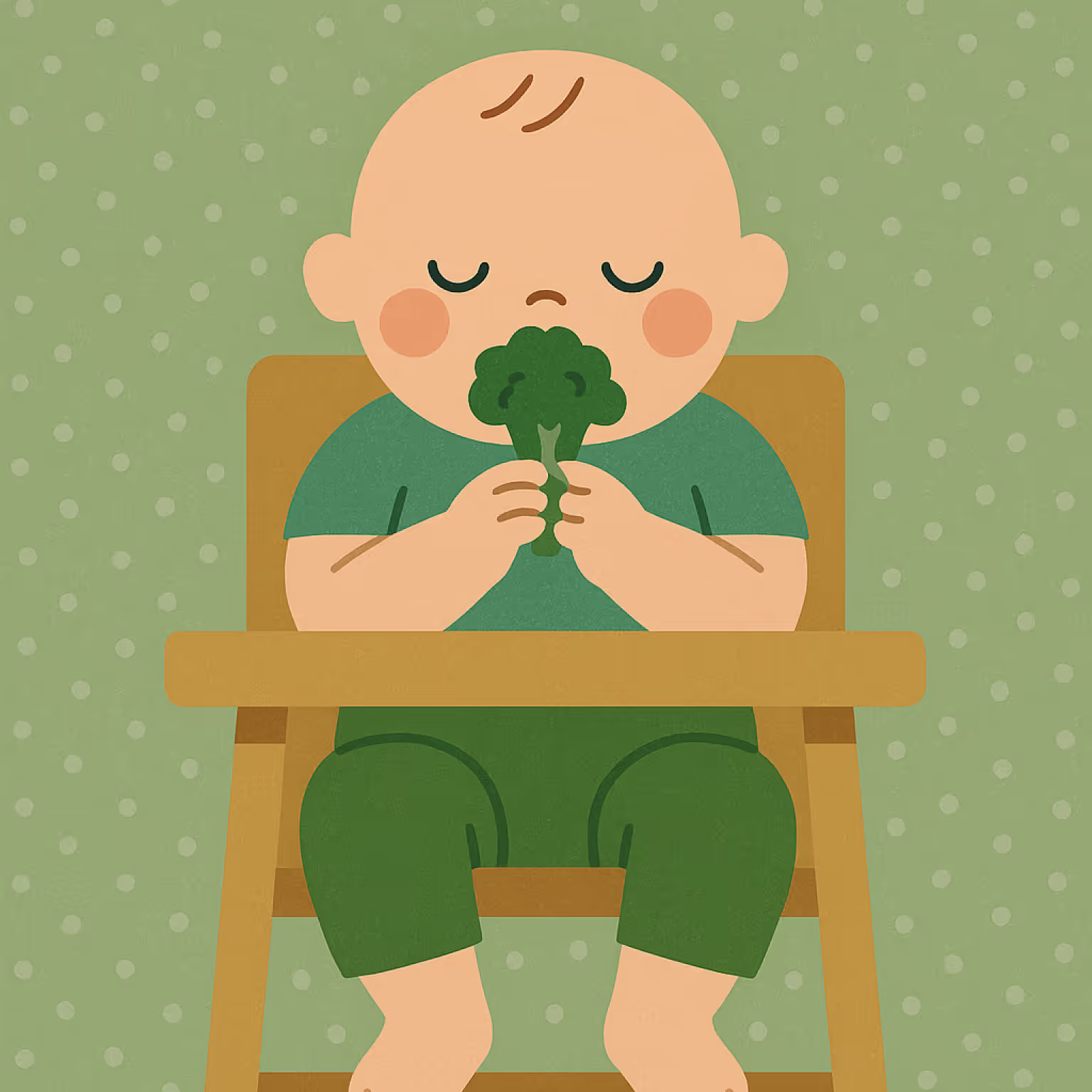
FROM FIRST BITES TO FAMILY MEALS
From first tastes to family meals — how to introduce solids, handle textures and allergens, and help your baby build a healthy relationship with food.


When is my baby ready for solid foods?
The guidance says around 6 months. But readiness is not just about age — it is about what your baby can actually do. Here is what to look for.
The 6-month guidance
Most major health organizations, including the WHO and NHS, recommend introducing solid foods at around 6 months of age (1). Before this point, the digestive system and kidneys are not sufficiently mature to handle food other than milk, and the risk of choking is higher because babies cannot yet sit with adequate head control. Starting before 4 months is not recommended under any circumstances.
Some parents feel pressure — from family, from comparison with other babies, or from a sense that their baby seems hungry — to start earlier. Frequent night waking, wanting more milk feeds, and watching you eat with interest are all normal infant behaviours that do not indicate readiness for solids. It is worth noting that babies often go through a growth spurt around 5 months and may seem hungrier — this is not a sign that they need solids.
Signs of readiness
Age alone is not sufficient. Most health professionals look for three signs together:
• Your baby can sit up with minimal support and hold their head steady;
• Your baby has lost the tongue-thrust reflex — the automatic pushing-out of anything placed in the mouth that protects young infants from choking;
• Your baby shows interest in food — reaching for it, watching you eat, opening their mouth when food is nearby;
Most babies show all three signs somewhere between 6 and 7 months. Some are ready slightly earlier, some later. Both are within the normal range.
A note on premature babies
If your baby was born prematurely, readiness for solids should be assessed against their corrected age — their age calculated from their original due date — rather than their actual birth date. Always discuss timing with your health visitor or paediatrician.
Sources:
(1) WHO. 'Complementary feeding.' World Health Organization, available at: who.int/health-topics/complementary-feeding
Solids - How to start
Purées, finger foods, or both? Once a day or on demand? Sitting where, cut how? Here is what the approaches actually involve — and what the evidence says about each.
Responsive feeding
The most important principle when starting solids is not which method you use — it is following your baby’s cues. Responsive feeding means offering food in a way that respects your baby’s signals of hunger, fullness, interest, and readiness, rather than following a fixed routine or approach. In practice, this means:
- Watch, don’t push. If your baby turns their head away, closes their mouth, or loses interest, the meal is over. Encouraging “just one more bite” works against the development of healthy appetite regulation.
- Follow your baby’s lead on texture and pace. Some babies take enthusiastically to soft pieces they can pick up themselves; others start more comfortably with smooth foods on a spoon. Both are fine, and most families use a mix. What matters is that textures progress gradually and that your baby is an active participant — not a passive recipient.
- Eat together when possible. Babies learn to eat by watching. Sitting together at mealtimes, eating the same food, and modelling enjoyment of a variety of foods is one of the most effective things you can do.
- Keep mealtimes calm and pressure-free. Stress and pressure at the table are associated with food refusal and anxiety around eating later in childhood. The goal of complementary feeding is exploration and positive association — not quantity consumed.
Gagging is a normal part of this process, particularly in the early weeks. It is a protective reflex, not a sign that something has gone wrong. There is more on gagging — and how to tell it apart from choking — in Card 4.
Knowing how to prepare each food safely for your baby’s age and stage can feel overwhelming at first. Solid Starts is a free, searchable app with preparation guidance and safety notes for hundreds of foods. Feeding Littles offers similar guidance with a slightly different format. Both are worth having on your phone before the first meal.
What to offer first
While there is no strict prescribed order for most foods, iron-rich foods should be introduced early and regularly, and allergens should be introduced one at a time. Vegetables are often suggested as a starting point simply because they are less sweet than fruit and may help establish acceptance of a wider flavour range early. Iron-rich foods — meat, fish, eggs, lentils, wholegrain cereals (wholegrain options should be prioritised over refined ones)— should be introduced early and regularly, as breastmilk alone does not provide sufficient iron beyond 6 months (2).
How much
In the early weeks, quantities are almost irrelevant. The purpose of complementary feeding is exploration and sensory-motor skills development, along side nutrition, as milk remains the primary source of nutrition until around 12 months. Expect most of the food to end up on the floor, the highchair, and your baby. This is normal and expected.
Texture progression
From smooth or very soft at the start, textures should progress gradually toward minced, chopped, and eventually family foods. By 12 months, most babies can manage soft pieces of most foods. By 18 months, most are eating a version of family meals with minor modifications. Progressing textures matters — babies who remain on smooth foods beyond around 9 to 10 months can develop texture aversion that becomes harder to address later. (3)
Eating position
Before food is even offered, position matters. Your baby needs to be seated upright — ideally at a 90-degree angle at the hips, knees and ankles, with feet supported and the back straight. A reclined or semi-supported position significantly increases the risk of choking because it prevents effective oral motor control and swallowing. A good high chair will support this posture naturally, but it is worth checking: feet dangling unsupported, a seat that tips the pelvis back, or a tray positioned too high can all affect your baby's ability to manage food safely.
As babies grow into toddlers, the same principle applies at the family table. A booster seat with foot support, or a well-fitted chair, makes a real difference to how well a toddler can focus on eating rather than on staying upright.
Babies and young children should always be seated and supervised during meals. Never offer food while your child is walking, lying down, in a car seat, or in a pushchair — these positions all increase choking risk.
Safe food preparation — cuts and sizes
How food is cut matters as much as what food you offer. Whole grapes, cherry tomatoes, chunks of raw carrot, whole nuts, sausages, and fruits and vegetables with tough skins like peaches, plums and bell peppers are among the most common choking hazards for babies and young children — not because they are inherently dangerous but because of their size, shape, and texture. Round foods should always be cut lengthways, not into rounds, which can form a seal in the airway. Hard raw vegetables should be cooked or grated until a child has sufficient molar teeth to chew them effectively, typically not until 12 months or later.
General size guidance:
- For babies starting solids, pieces should be roughly the size and shape of an adult finger — long enough to grip with a fist, soft enough to squash between your fingers with gentle pressure.
- From around 9 months, soft bite-sized pieces that can be picked up with the hands.
- From around 12 months, soft bite-sized pieces offered alongside a utensil for practice, or soft and larger pieces to practice biting and tearing — foods that require a lot of chewing, like steak, should still be shredded.
Sources:
(2) Daniels L. et al. 'Baby-Led Introduction to Solids (BLISS) study.' BMC Pediatrics, 2015. pubmed.ncbi.nlm.nih.gov/26018317
(3) Coulthard H. et al. 'Delayed introduction of lumpy foods to children during the complementary feeding period affects child's food acceptance and feeding at 7 years of age.' Maternal & Child Nutrition, 2009. pubmed.ncbi.nlm.nih.gov/19888924
Allergen Introduction
The guidance on allergens has changed significantly in recent years. Early introduction is now recommended — here is what that means in practice.
The shift in guidance
For many years, parents were advised to delay introducing common allergens — peanuts, eggs, dairy, wheat, fish — until after the first year. The evidence has shifted substantially. Current guidance now recommends introducing allergenic foods early and regularly, starting around 6 months (4). Delaying the introduction does not reduce the risk of allergy — and may increase it.
The main allergens to introduce
The fourteen major allergens recognized in EU and UK food law include:
- Milk
- Eggs
- Peanuts
- Tree nuts (almonds, cashews, walnuts, pistachios, and others)
- Wheat and gluten
- Fish
- Crustaceans and shellfish
- Sesame
- Soy
- Celery
- Mustard
- Lupin
- Molluscs
- Sulphur dioxide and sulphites
When introducing allergens, follow these four steps:
- Offer the allergen as the only new food that day;
- Introduce it early in the day so you can monitor for any reaction;
- Start with a small quantity — around half a teaspoon — alongside your baby’s usual meal;
- If there is no reaction, repeat the exposure after 48 hours, and again after a further 48 hours before considering it tolerated.
How to introduce peanuts
Whole peanuts and large pieces of nut are a choking hazard and should never be given to babies or young children. Smooth peanut butter thinned with water or breast milk, or peanut powder mixed into food, are safe ways to introduce peanuts. Once introduced without reaction, continue offering regularly — weekly exposure appears to be important for maintaining tolerance (4).
A Danish-specific note on eggs
The Danish Health Authority (Sundhedsstyrelsen) has a specific recommendation on eggs that is worth highlighting. In its 2022 revised guidelines on food allergy prevention — updated again in May 2024 — Sundhedsstyrelsen recommends introducing hard-boiled egg as a regular part of the diet from 4 to 6 months of age, specifically half a small hard-boiled egg together with other food twice a week. This level of specificity goes beyond general allergen guidance and reflects evidence that early and regular egg exposure can meaningfully reduce the risk of egg allergy developing (5).
What a reaction looks like
Mild allergic reactions include hives ( raised, itchy red patches on the skin ), swelling around the mouth, or vomiting. It is also worth noting that reactions to high-histamine foods — such as tomatoes, strawberries, and spinach — can trigger localised skin reactions including rashes, hives, or worsening eczema, typically around the mouth. These are often mistaken for true allergies but are histamine reactions rather than IgE-mediated responses. A GP or allergy specialist can help distinguish between the two.
A severe allergic reaction (anaphylaxis) involves difficulty breathing, significant swelling of the throat or tongue, loss of consciousness, or collapse — this is a medical emergency requiring an immediate call to emergency services.
Higher-risk babies
Babies with severe eczema or an existing egg allergy are at higher risk of peanut allergy. If your baby has either of these, speak to your GP or paediatrician before introducing peanuts — they may recommend an allergy assessment first.
After introduction
Once an allergen has been introduced without reaction, keep offering it regularly. Tolerance can be lost if exposure stops for several months.
Sources:
(4) Du Toit G. et al. 'Randomized trial of peanut consumption in infants at risk for peanut allergy (LEAP trial).' NEJM, 2015. pubmed.ncbi.nlm.nih.gov/25705822.
(5) Sundhedsstyrelsen. 'Ernæring til spædbørn og småbørn — en håndbog for sundhedspersonale, version 4.' Danish Health Authority, updated May 2024. sst.dk/Udgivelser/2022/Ernaering-til-spaedboern-og-smaaboern-en-haandbog-for-sundhedspersonale.
Starting Solids - Common challenges
Gagging, refusal, food being thrown across the room — feeding a baby is rarely as straightforward as it looks. Here is what is normal and what to do about it.
Gagging
Gagging is a normal and protective reflex in young babies —it prevents food from entering the airway before the baby is ready to swallow it. It can look alarming, particularly in the early weeks of solids, but it is not choking. Gagging involves retching sounds, watering eyes, and sometimes bringing food forward in the mouth. Choking is silent — a choking baby cannot make sound, is unable to cough, and may turn red or blue. Knowing the difference matters. A first aid course covering infant choking is worth doing before starting solids.
As babies gain experience with food and develop better oral motor control, gagging reduces significantly. It typically becomes less frequent after a few weeks of exposure to finger foods.
Food refusal
Food refusal in the early months of solid introduction is entirely normal and should not be interpreted as dislike. Research suggests that some babies need to be exposed to a new food up to 15 to 20 times before accepting it (6). Offering a refused food repeatedly — without pressure or reaction — is the most effective strategy. Removing food from the menu because it was refused once or twice is one of the most common ways variety narrows early.
Sensory-based feeding difficulties
Some children struggle with eating because specific food textures, tastes, or smells feel unpleasant to them. This is called a sensory‑based feeding difficulty. Your child may eat well with familiar foods but avoid new or certain ones. This doesn’t mean they are picky or refusing on purpose. Their body may be signaling that a food feels “too much” right now.
A feeding therapist or paediatric occupational therapist can gently help children explore foods step by step, without pressure, feeling safer and more regulated around food.
The toddler stage: strong opinions and food refusal
From around 12 to 18 months, many babies who were previously good eaters become more selective. This is developmentally normal — toddlers are asserting autonomy, and the table is one of the places they can. Neophobia (fear of new foods) is extremely common in this age group and typically peaks between 18 and 24 months (7).
Strategies that tend to help:
• Continuing to offer refused foods without pressure;
• Eating together as a family where possible — children learn by watching;
• Avoiding battles over eating, which tend to entrench refusal;
• Separating your anxiety about what your child is eating from the meal itself — easier said than done, but important;
If refusal is severe, your child is losing weight, or meals have become consistently distressing for the whole family, this is worth raising with your paediatric dietitian or feeding therapist.
Gagging versus vomiting at mealtimes
Some babies spit up or posset during or after meals, particularly in the early months of solid feeding. Reflux (spitting up) is small amounts of milk or food coming back up — very common and usually harmless. Projectile or forceful vomiting is different. If vomiting at mealtimes is forceful, frequent, or associated with clear distress, speak to your GP as it may warrant assessment.
Sources:
(6) Birch L.L., Marlin D.W. 'I don't like it; I never tried it: effects of exposure on two-year-old children's food preferences.' Appetite,1982. pubmed.ncbi.nlm.nih.gov/7159252
(7) Dovey T.M. et al. 'Food neophobia and picky/fussy eating in children.' Appetite, 2008. pubmed.ncbi.nlm.nih.gov/17919776
Milk Feeds during the transition
Starting solids does not mean stopping milk. Here is how milk feeds change across the first 24 months — and how to navigate the transition without affecting supply or nutrition.
6 to 12 months: milk is still primary
Between 6 and 12 months, breast milk or formula remains the primary source of nutrition. Solid foods during this period are complementary — they build skills, expand flavour exposure, and begin to contribute nutrients like iron — but they do not replace milk. Most babies at this stage need around 500 to 600 ml of formula per day if formula-fed, or continued breastfeeding on demand if breastfed (1).
Timing will depend on your baby's routine and wake windows. The key principle is that no milk feeds should be eliminated at this stage unless your baby naturally drops them — the breast can be offered before, during, or after solid meals.
The transition around 12 months
Around the first birthday, the balance usually begins to shift. Solid food becomes the primary source of nutrition, and milk moves to a complementary role. Formula is no longer needed after 12 months — whole cow's milk can be introduced as a drink alongside a balanced diet (1). Nor are "growth milks" or toddler milks necessary: after the first year, a child eating a reasonable variety of foods does not need them.
Breastfeeding can continue for as long as mother and baby choose — there is no upper age limit, and breastmilk continues to provide nutritional and immunological benefits beyond infancy.
It is worth noting that Sundhedsstyrelsen — the Danish Health Authority — is explicit about why cow's milk should not be given as a drink before 12 months: cow's milk contains approximately three times the protein of breast milk and has a low iron content. Danish guidelines note that excessive protein intake in infancy is linked to a higher risk of obesity later in life. This is the rationale Danish health visitors apply, and it is worth being aware of if your sundhedsplejerske has given you this guidance specifically (5).
Many parents worry at this stage that their baby is not eating enough solid food to compensate for reduced milk feeds. As long as your baby is growing well and eating a reasonable variety, appetite will self-regulate. The transition rarely happens overnight.
From 12 to 18 months: family food
By 12 to 18 months, most babies are eating versions of family meals. Milk feeds typically settle into a predictable rhythm for formula-fed babies — usually one or two feeds per day, often a morning and bedtime feed — while breastfed babies may continue to nurse more frequently, and this variation is normal. Solid food provides the majority of nutrition in this phase. Cow's milk intake should not exceed around 400 ml per day, as higher volumes can displace solid food intake and reduce iron absorption (7).
What to watch
If your baby is drinking large volumes of milk and showing little interest in solid food beyond 12 months, it is worth discussing with your health visitor. Excessive milk intake in the second year is one of the most common causes of iron deficiency in toddlers.
Sources:
(1) World Health Organization. WHO Guideline for complementary feeding of infants and young children 6–23 months of age. Geneva: WHO, 2023. who.int/publications/i/item/9789240081864
(5) Sundhedsstyrelsen. 'Ernæring til spædbørn og småbørn — en håndbog for sundhedspersonale, version 4.' Danish Health Authority, updated May 2024. sst.dk/Udgivelser/2022/Ernaering-til-spaedboern-og-smaaboern-en-haandbog-for-sundhedspersonale
(7) SACN. 'Feeding in the First Year of Life.' Scientific Advisory Committee on Nutrition, 2018.
Starting Solids - Who can help
Feeding challenges are among the most common reasons parents seek specialist support in the first two years. Meet the specialists on Sage Nest who can help.
Pediatric dietitians - Specialists in child nutrition who can assess your baby's diet advise on allergen introduction, support iron and nutrient sufficiency, and help with fussy eating and food refusal. A pediatric dietitian is the right first port of call for most nutritional concerns.
Feeding therapists - Specialists in the sensory and oral-motor aspects of feeding. who work with babies and toddlers who have oral motor difficulties, sensory feeding difficulties, or significant feeding refusal. Feeding therapy is often delivered by speech and language therapists or occupational therapists with specialist feeding training — who can also assess the sensory dimension where this is a contributing factor.
Lactation consultants - If you are navigating the transition from breastfeeding to solid food and want support maintaining supply while introducing solids, a lactation consultant can help you manage the balance.
Health visitors - Your health visitor is often the first point of contact for feeding concerns. For more specific or persistent difficulties, the specialists above can provide focused one-to-one support.
Starting Solids - FAQs
How do I know my baby is eating enough? Is gagging dangerous? Can I start before 6 months? Find answers here.
Q How do I know if my baby is eating enough?
In the first months of introducing solids, this question almost always has the same answer: if your baby is continuing to grow well and taking their milk feeds, they are getting enough. Solid food intake at this stage is not the measure of nutritional adequacy — milk is. From 12 months onward, variety and growth are better guides than quantity. If you are genuinely worried, a paediatric dietitian can assess your baby's intake properly.
Q My baby gags a lot. Should I be worried?
Gagging is a normal protective reflex, particularly in the early weeks of introducing solids. It is not choking. If your baby gags, stay calm —intervention usually makes it worse. Gagging that persists significantly beyond the first few months, or that is associated with distress or weight faltering, is worth raising with your health visitor. A feeding therapist can assess whether an oral motor issue is involved.
Q Can I start solids before 6 months?
Not before 4 months, under any circumstances — the digestive system is not ready and the choking risk is too high. Between 4 and 6 months, some parents choose to start if their baby shows clear signs of readiness, though most health organisations recommend waiting until 6 months. If you are considering starting before 6 months, speak to your health visitor first — they can help you assess whether your baby shows the right developmental signs of readiness.
Q My toddler has suddenly stopped eating foods they used to love. Is this normal?
Yes — this is extremely common from around 12 months onward and tends to peak between 18 and 24 months. It is linked to the development of autonomy and food neophobia, not to a change in your cooking or your parenting. Continue offering the refused foods without pressure. Most toddlers cycle back to previously accepted foods in time.
Q Do I need to give my baby water?
Small amounts of cooled boiled water can be offered from 6 months alongside solid food. In Denmark, tap water is safe for babies from 6 months without boiling. Water should be offered with every meal from 6 months — it supports digestion and helps prevent constipation. It also helps babies get used to drinking from an open cup and supports dental health as teeth emerge. From 12 months, tap water is fine without boiling.
Q When should I be worried about feeding?
Speak to your health visitor or GP if your baby or toddler is losing weight or not gaining weight adequately, if meals are consistently distressing for your child or for the family, if your child is eating fewer than 20 different foods and the list is shrinking, or if feeding difficulties are affecting your child's growth, sleep, or development. Early intervention for feeding difficulties is almost always more effective than waiting.
EXPLORE THE SPECIALISTS

Evidence-based nutrition support for pregnancy, postpartum, the journey from milk to family foods, and childhood feeding challenges, helping families build confidence and positive mealtimes.


No matches found. Please try again.