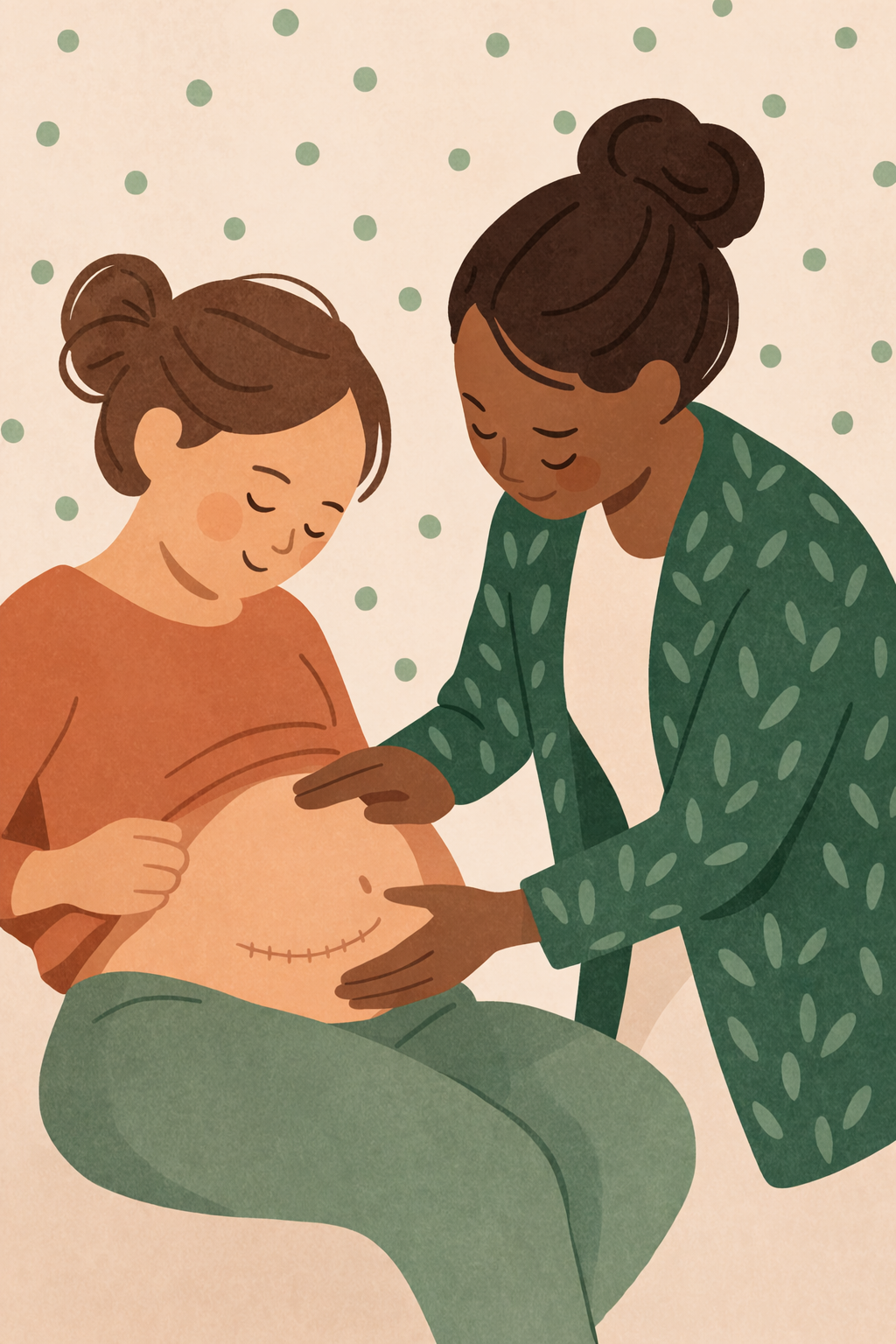
RECOVERY IS NOT A RACE. HERE IS WHAT HEALING ACTUALLY TAKES
Recovery after birth takes longer than most people expect — physically and emotionally. Here's what's happening in your body, what to expect along the way, and who can help.


What is happening to your body after birth
The moment your baby is born, your body begins a significant transition. Understanding what is happening makes it easier to know what to expect — and what to pay attention to.
The hormonal shift
During pregnancy, estrogen and progesterone reach the highest levels they will ever be in your life. The moment the placenta is delivered, both hormones drop sharply and rapidly. This hormonal crash is one of the most dramatic physiological events the human body experiences, and it happens at the same time as you are meeting your baby, recovering from birth, and beginning to care for a newborn. The emotional volatility of the early days — often called the baby blues — is rooted in this shift. It is not weakness, it is biology.
Lochia
After birth, your uterus sheds its lining through postpartum bleeding known as lochia. It begins as a heavy, bright red flow in the first days, gradually becoming lighter and changing to pink, then brown, then yellowish-white over the course of two to six weeks (1). This is normal and expected. If bleeding suddenly becomes heavier again — soaking more than one pad per hour — or if you pass large clots, contact your midwife or GP promptly.
Uterine involution and afterpains
Your uterus, which expanded significantly during pregnancy, contracts back toward its pre-pregnancy size over the weeks following birth. These contractions — sometimes called afterpains — can be felt as cramping, particularly during breastfeeding, when oxytocin released by feeding stimulates further contractions. They tend to be stronger in subsequent pregnancies. Most afterpains settle within the first week.
Your body is finding balance again
In the first days after birth, your body begins releasing the extra fluid it held onto during pregnancy. You might notice more frequent trips to the bathroom, swelling that gradually eases, or waking in the night drenched in sweat.
This can feel intense, but it is often a normal part of postpartum recovery. Gentle care, dry clothes, hydration, and rest can help you feel more comfortable while your body adjusts. If the sweating feels unusual or comes with fever, chills, strong pain, bad-smelling bleeding, or feeling seriously unwell, please seek medical support.
Exhaustion beyond tiredness
The fatigue of early parenthood is not simply the result of broken sleep, though that is part of it. Your body has also completed an enormous physical event and is simultaneously healing, producing milk if you are breastfeeding, and regulating a new hormonal landscape. Rest is not optional in this period — it is part of recovery.
Sources:
(1) Oppenheimer LW et al. 'The duration of lochia.' BJOG, 1986. pubmed.ncbi.nlm.nih.gov/3964538
Vaginal birth recovery
Whether you had a straightforward birth or a more complex one, your body needs time to heal. these are some of the challenges you might experience during the first weeks
Perineal tears and episiotomy
During a vaginal birth, the perineum — the area between the vagina and rectum — may tear naturally or be cut via an episiotomy to assist delivery. Tears are graded from first degree (superficial, often healing without stitches) to fourth degree (extending into the anal sphincter, requiring surgical repair) (2). Most tears are first or second degree and heal well with care. Third and fourth degree tears require more specialist follow-up and should be monitored carefully in the weeks after birth.
Stitches and healing
If you have stitches, they are typically dissolvable and do not need to be removed. The area may feel sore, swollen, and uncomfortable for the first week or two. Keeping the perineum clean — rinsing with warm water after using the toilet — helps healing. Sitting on a soft cushion or pillow can ease discomfort. Cold packs in the first 24 to 48 hours can help with swelling.
Most perineal wounds heal significantly within two to four weeks, though full tissue healing takes longer. If you notice increased pain, swelling, discharge with an unpleasant smell, or a wound that appears to be opening, contact your midwife or GP — these can be signs of infection.
The first bowel movement
Many people are unprepared for how much they dread the first bowel movement after a vaginal birth. Constipation, fear of pain, and the sensation of pressure near healing stitches all contribute. Staying hydrated, eating enough fibre, and using a footstool to elevate your feet while on the toilet can all help. If you are struggling significantly, speak to your midwife — stool softeners are safe to use in the postpartum period.
Abdominal Support After Birth
After birth, it's common to feel weak, heavy, or "wobbly" through the abdomen as your organs, muscles, and tissues gradually settle back into place. Some mothers find gentle abdominal support or wrapping comforting in the first days postpartum. If you choose to use one, a support garment or wrap should always feel comfortable — never tight or restrictive — and is best worn only for the first couple of weeks. Long-term or overly tight binding can interfere with your body's natural recovery and with the abdominal muscles' ability to rebuild strength on their own.
Week by week
The first week is typically the most uncomfortable. By two weeks, most women report a significant reduction in perineal pain. Between 6 - 8 weeks— the traditional postnatal check — many feel substantially recovered physically, though this varies widely. It is worth knowing that the after birth check is often brief and may not cover everything you want to discuss. You are entitled to raise any concern, however small it feels.
Sources:
(2) Sultan AH et al. 'Obstetric perineal trauma.' The Obstetrician and Gynaecologist, 2007. obgyn.onlinelibrary.wiley.com/doi/10.1576/toag.9.3.167.27354
C-section recovery
A C-section is major abdominal surgery. Recovery takes longer than many people expect — and longer than many are told. Here is what it actually involves.
What a C-section involves
A caesarean section involves cutting through seven layers of tissue — skin, fat, fascia, and uterus — and the recovery reflects that. It is one of the most commonly performed surgical procedures in the world, but being common does not make it minor. Framing your recovery as recovery from major surgery — and giving yourself the time that entails — is important.
The first 24 to 48 hours
After a C-section you will have a urinary catheter, which is usually removed the following morning. You will be encouraged to get up and move as soon as it is safe to do so — typically within 12 to 24 hours — because early movement reduces the risk of blood clots. The first time you stand is often the hardest. The wound will be covered with a dressing, and you will be given pain relief. Do not wait until pain becomes severe before asking for it — staying ahead of pain makes movement and recovery easier (3).
Wound care
Once the dressing is removed — usually after 24 hours — keep the wound clean and dry. Avoid submerging it in water (baths, swimming) until it is fully healed, typically around four to eight weeks. Wear high-waisted underwear or loose clothing that does not press on the wound. If you notice redness, swelling, discharge, or the wound begins to separate, contact your GP or maternity unit.
Mobility and lifting restrictions
After a C-section, it's best to avoid activities that strain the abdomen during the first six to eight weeks of recovery — heavy lifting, biking, intense exercise, and driving before you feel physically comfortable and able to react quickly behind the wheel. As a general guide, avoid driving for the first six weeks, and don't lift anything heavier than your baby. This isn't overcaution: the internal layers of the wound are still healing long after the skin has closed, and overdoing it in the early weeks can affect how well that deeper tissue knits back together.
Scar tissue and massage
The scar that forms after a C-section is not just on the surface. Internally, adhesions — bands of scar tissue — can form between layers of tissue. These can sometimes contribute to pain, pulling sensations, or discomfort during movement or sex in the months after birth. From around eight weeks, once the wound is fully healed, gentle scar massage can help soften the tissue and reduce adhesion formation. A pelvic floor physiotherapist can guide you through this safely.
The emotional dimension of C-section recovery
For some parents, a C-section — particularly an unplanned one — brings complex emotions: disappointment, a sense of loss around the birth experience, or feeling that their body failed them. These feelings are valid and worth acknowledging. If they are persisting or intensifying, speaking to a postnatal wellbeing coach or therapist can help.
Sources:
(3) NICE. 'Caesarean birth: NICE guideline NG192.' National Institute for Health and Care Excellence, 2021. nice.org.uk/guidance/ng192
Pelvic Floor Recovery
The pelvic floor is one of the most affected parts of your body after birth — and one of the least talked about. Here is what it is, what can go wrong, and why early support matters.
What is the pelvic floor?
The pelvic floor is a group of muscles and connective tissue that forms the base of the pelvis, supporting the bladder, bowel, and uterus. During pregnancy, it bears a significant additional load. During vaginal birth it is stretched considerably as the baby passes through. Even in C-section births, the weight of pregnancy and the effects of hormones like relaxin on connective tissue mean the pelvic floor is affected (4).
What can go wrong?
• Urinary incontinence — leaking when you cough, sneeze, laugh, or exercise (stress incontinence), or a sudden urgent need to urinate that is hard to control (urge incontinence). Leaking after birth is extremely common but is not something you simply have to accept.
• Pelvic organ prolapse — a feeling of heaviness, dragging, or pressure in the pelvis, sometimes described as a feeling that something is falling out. This occurs when pelvic organs descend into or through the vaginal wall. Mild prolapse is very common after birth and often improves significantly with pelvic floor rehabilitation.
• Pelvic pain and sexual discomfort — pain in the perineum, tailbone, hips, or during sex can persist beyond the initial healing period and is often linked to pelvic floor tension or scarring. Pain during sex is common in the months after birth but is not inevitable, and it is not something to simply wait out.
Pelvic floor exercises
Pelvic floor exercises — contracting and releasing the muscles as if stopping the flow of urine — are widely recommended after birth. They are beneficial, but technique matters. Many people unconsciously perform them incorrectly, or perform them when their pelvic floor is actually too tight rather than too weak. If exercises do not seem to be helping, or if you are unsure whether you are doing them correctly, a pelvic floor physiotherapist can assess you directly (5).
The gap in the after birth medical check
The traditional postnatal check is often the only formal point of contact for physical recovery — and it frequently does not include a pelvic floor assessment. Many pelvic floor problems go unidentified and untreated for months or years as a result. You do not need a referral to see a pelvic floor physiotherapist privately, and early assessment — particularly if you have any symptoms — can make a significant difference to long-term outcomes.
Sources:
(4) Bø K et al. 'Evidence-based physical therapy for the pelvic floor.' Elsevier, 2015.
(5) Dumoulin C et al. 'Pelvic floor muscle training versus no treatment for urinary incontinence in women after childbirth.' Cochrane Database Syst Rev, 2018. pubmed.ncbi.nlm.nih.gov/30288727
Nutrition in the post-partum period
Your body has just done something enormous. What you eat in the weeks and months after birth matters more than most people realise — and looks very different from any diet you have followed before.
Why nutrition matters more in this phase
The postpartum period places significant nutritional demands on the body. You are recovering from either surgery or the physical exertion of labor, your tissues are healing, your hormones are recalibrating, and if you are breastfeeding, you are producing milk — which requires an additional 300 to 500 calories per day above your normal intake (6) This is not the time to restrict food. It is the time to nourish yourself deliberately.
What your body needs most
Iron
Blood loss during birth depletes iron stores, and low iron is one of the most common causes of postpartum exhaustion that goes beyond what sleep deprivation alone explains. Red meat, legumes, dark leafy greens, and fortified cereals all contribute. Vitamin C consumed alongside plant-based iron sources improves absorption. If you feel persistently exhausted, a simple blood test can check whether iron deficiency is a factor.
Protein
Protein is essential for tissue repair and recovery. Aim to include a source of protein at every meal — eggs, meat, fish, dairy, legumes, or tofu. This matters especially in the first weeks when healing is most active.
Omega-3 fatty acids
The brain draws heavily on omega-3s during pregnancy, and stores can be depleted by the time you give birth. Oily fish (salmon, mackerel, sardines), walnuts, and flaxseed are good sources. Omega-3s are also associated with lower rates of postnatal depression, though the relationship is complex (7)
Calcium
If you're breastfeeding, your body will prioritise your milk supply — drawing calcium from your own bones to make up the difference when your diet doesn't provide enough. To protect your bone density, breastfeeding mothers are encouraged to aim for a high daily calcium intake of roughly 1,000–1,300 mg, through food where possible and supplements where needed. Dairy, fortified plant milks, sardines with bones, and dark leafy greens all help you get there.
Hydration
Breastfeeding increases your fluid needs significantly, and thirst isn't always a reliable signal in the early postpartum weeks — especially when you're exhausted or running on broken sleep. Staying hydrated supports your recovery, energy, milk supply, and overall wellbeing. Water matters most, but it doesn't have to be your only source. Soups, teas, milk, smoothies, electrolyte drinks, and other nourishing fluids all count too. Keeping a drink within reach during feeds or rest is a small habit that can make a real difference.
What this is not
This is not a weight loss plan. The postpartum period is not the time to restrict calories or pursue a specific body shape. Your body is doing recovery work that requires fuel. Undereating in this phase — particularly while breastfeeding — can affect milk supply, slow healing, worsen mood, and deepen fatigue.
Sources:
(6) Kominiarek MA, Rajan P. 'Nutrition Recommendations in Pregnancy and Lactation.' Medical Clinics of North America, 2016. pubmed.ncbi.nlm.nih.gov/27745590
(7) Wojcik OP et al. 'The association of dietary omega-3 fatty acids and fish consumption in pregnancy with postnatal depression.' European Journal of Obstetrics & Gynecology, 2011. pubmed.ncbi.nlm.nih.gov/21130566
Your body, movement and recovery
Coming back to physical activity after birth is not about getting your body back. It is about rebuilding a relationship with a body that has changed — on its own timeline, not anyone else's.
Your body has changed — and that is not a problem to fix
Pregnancy and birth change the body in ways that are real, significant, and in many cases permanent. The abdominal muscles separate during pregnancy to accommodate the growing uterus — a process called diastasis recti — and do not simply snap back afterward. The pelvic floor has been under load for nine months and, in a vaginal birth, has been stretched considerably. Joints loosened by relaxin during pregnancy take time to restabilize. Posture shifts. The centre of gravity shifts.
Many people who were fit and active before pregnancy find that their body simply does not respond the way it used to in the early postpartum months. That is not failure. It is a body that is still in transition. Recognising this — rather than fighting it — is the starting point for a return to movement that actually serves you.
When to start moving again
Gentle walking can generally begin as soon as you feel ready in the first days after a vaginal birth, or once you are comfortable doing so after a C-section. This is very different from returning to structured exercise. The general guidance is to wait until after the medical check before beginning anything more demanding — and even then, to return gradually and with attention to how your body responds (8).
For C-section recovery specifically, the internal wound is still healing well beyond eight weeks. Many physiotherapists recommend waiting closer to twelve weeks before beginning any core-focused exercise, and introducing movement progressively from there.
The 40-day rule
In many cultures and healthcare systems across Europe, Latin America, the Middle East, and beyond, women are traditionally advised to rest for 40 days after birth before resuming physical activity. This is not simply folk wisdom — it reflects a recognition, embedded in many medical traditions, that the body needs a protected period of recovery before being asked to do more. In some countries this is formalised through a specialist postnatal visit at around six weeks, after which a doctor or midwife assesses whether the woman is ready to return to activity.
The specific number varies — 40 days, six weeks, eight weeks — but the underlying principle is consistent: return to movement should be gradual, assessed, and cleared by someone who has actually examined you, not based on a general timeline or on how you feel on a good day. If you have been given a specific instruction to wait for a specialist visit before resuming activity, that guidance exists for good reason. The visit is also an opportunity to raise any concerns about your recovery that may not have come up at the six-week check.
The pelvic floor first
Before returning to any high-impact activity — running, jumping, heavy lifting — the pelvic floor needs to be assessed and rehabilitated. Returning to running at six weeks, for example, while the pelvic floor is still recovering, is one of the most common causes of long-term incontinence and prolapse in women who exercised before and during pregnancy. A pelvic floor physiotherapist can tell you when your body is ready for specific activities — and that assessment is worth having regardless of whether you have obvious symptoms.
Diastasis recti
If you notice a gap or ridge running down the centre of your abdomen — particularly when you sit up or strain — you may have diastasis recti. This is extremely common and affects the majority of women to some degree after pregnancy (9). It does not mean you cannot exercise — but it does mean that certain exercises (sit-ups, crunches, heavy lifting with breath-holding) can make it worse rather than better. A physiotherapist or women's health specialist can assess the gap and guide you toward exercises that support healing rather than worsening separation.
Weight and body composition
Postpartum weight loss does not follow a predictable timeline, and the expectation that it should is one of the most damaging myths in postpartum culture. Many women expect that the weight gained during pregnancy will come off relatively quickly — and some of it does, in the weeks after birth. But for many, weight does not shift significantly until breastfeeding ends, and for some, it does not shift even then.
Stopping breastfeeding does not automatically trigger weight loss. For some women, the hormonal changes that follow weaning can actually cause a temporary increase in appetite and fluid retention. This is normal, and it is not a sign that something has gone wrong.
The postpartum body is not a problem to be solved. It is a body doing recovery work under significant physical and emotional load. Pursuing aggressive weight loss in this period — through calorie restriction or high-intensity exercise before the body is ready — is likely to slow physical recovery, worsen mood, and deepen fatigue.
What actually helps
Consistent gentle movement — walking, swimming once wounds are healed, yoga adapted for postpartum recovery — supports mood, energy, and physical healing without placing stress on a body that is still rebuilding. Building back gradually, guided by how you feel rather than by how quickly you want to return to a previous state, is almost always the approach that leads to better long-term outcomes.
If you want support returning to exercise in a way that is safe for your specific recovery, a women's health physiotherapist or postnatal fitness specialist can guide you.
Sources:
(8) Goom T, Donnelly G, Brockwell E. 'Returning to running postnatal — guidelines for medical, health and fitness professionals.' British Journal of Sports Medicine, 2019. pubmed.ncbi.nlm.nih.gov/31493643
(9) Lee DG et al. 'Diastasis rectus abdominis and lumbo-pelvic pain and dysfunction.' Manual Therapy, 2008. pubmed.ncbi.nlm.nih.gov/17659977
The emotional side of recovery
The emotional experience of early parenthood is as real as the physical one. Here is what is normal, what is worth paying attention to and what support looks like.
Baby blues
In the first days after birth — often peaking around day three to five — many new parents experience a wave of emotional fragility: tearfulness, mood swings, irritability, and feeling overwhelmed, often without a clear reason. This is known as the baby blues, and it is thought to affect up to 80% of new mothers. (6) It is directly linked to the hormonal shift that follows the delivery of the placenta, and it typically resolves on its own within a week or two. It does not require treatment, but it does require kindness — to yourself and from those around you.
Postnatal depression
Postnatal depression (PND) is different from the baby blues. It is a clinical condition that affects around one in five new mothers — and is significantly underdiagnosed (9). PND can develop at any point in the first year after birth, not just in the early weeks. Symptoms include persistent low mood, loss of interest or pleasure in things you usually enjoy, difficulty bonding with your baby, feelings of worthlessness or guilt, changes in appetite or sleep beyond what a newborn explains, and in some cases, thoughts of harming yourself.
PND is not a sign that you are a bad parent. It is not caused by anything you did or did not do. It is a medical condition that responds well to treatment — including talking therapy, medication, or both. If you recognise these symptoms in yourself, please speak to your GP or health visitor. You do not need to be at crisis point to ask for help (10).
Postnatal anxiety
Postnatal anxiety is at least as common as PND but receives far less attention. It can present as constant worry about your baby's health or safety, difficulty sleeping even when your baby sleeps, a feeling that something terrible is about to happen, physical symptoms like a racing heart or tight chest, or an inability to switch off. If anxiety is dominating your experience of early parenthood, that is worth addressing — not normalising.
The identity shift
Becoming a parent involves a profound shift in identity that is rarely talked about honestly. The term matrescence — the developmental transition into motherhood — describes the psychological transformation that accompanies having a child (11). It can involve grief for your previous self, uncertainty about who you are now, and a complicated relationship with the expectations placed on new mothers. These feelings are not a sign that something has gone wrong. They are part of a significant life transition.
Your relationship
The arrival of a baby changes every relationship in the household. Partners may have very different experiences of the postpartum period — one of whom has gone through a major physical event, both of whom are sleep-deprived, and all of whom are navigating a new dynamic. Conflict, distance, and difficulty communicating are extremely common in the first months. Acknowledging this rather than expecting it to resolve on its own is the first step.
A note on feeding your baby
If you chose to breastfeed and it did not work out, it is worth naming that many parents carry grief or guilt about this long after the decision has been made. That weight is real. You do not have to carry it alone.
Sources:
(9) Henshaw C. 'Mood disturbance in the early puerperium.' Archives of Women's Mental Health, 2003. pubmed.ncbi.nlm.nih.gov/14615921
(10) Gavin NI et al. 'Perinatal depression: a systematic review of prevalence and incidence.' Obstetrics & Gynecology, 2005. pubmed.ncbi.nlm.nih.gov/16260528
(11) Matrescence concept: 'Aurélie Athan.' Columbia University, .
Recovery after birth - Who can help
Recovery after birth involves more than a six-week check. Meet the specialists on Sage Nest who support post partum recovery.
Pelvic floor physiotherapists - Specialists in assessing and rehabilitating the pelvic floor after birth. They work with incontinence, prolapse, pelvic pain, scar tissue, and pain during sex. A pelvic floor assessment is something every post partum parent deserves access to, not just those with obvious symptoms.
Postnatal wellbeing coaches - Trained to support the emotional and psychological dimension of early parenthood, including identity shift, relationship changes, and the transition into parenthood. They are a valuable first point of contact for parents who are struggling and not sure where to start.
Lactation consultants - If feeding difficulties are contributing to your postpartum experience, see the Breastfeeding microhub for specialist support.
Postpartum doulas - Offer practical, emotional, and educational support during the postpartum period, helping families navigate recovery, feeding, newborn care, and the transition into parenthood. Some postpartum doulas also prepare nourishing meals, support the household in gentle ways, and help create space for the mother and family to rest and recover.
Recovery After birth - Frequently Asked Questions
When will I feel like myself again? Is pain during sex normal? What is the difference between baby blues and PND? Find answers here.
Q When will I feel like myself again?
This is one of the most common questions new parents ask — and one of the hardest to answer honestly. Physical recovery varies enormously depending on birth type, any complications, and individual factors. Many parents feel substantially better physically by six to eight weeks. Full recovery — particularly of the pelvic floor and core — can take six months to a year. Emotionally, the transition into parenthood is ongoing. Most parents report feeling more settled by around three to four months, as sleep improves and confidence builds. If you do not feel like yourself after several months, it is worth speaking to your GP.
Q Is pain during sex after birth normal?
Pain during sex in the weeks immediately following birth is extremely common and expected. Tissue is still healing, hormone levels — particularly if you are breastfeeding — can cause vaginal dryness, and the muscles of the pelvic floor may be tight or tender. Most people are advised to wait until bleeding has stopped and they feel ready, typically around six weeks. If pain during sex persists beyond three to four months, or is severe, it is worth seeing a pelvic floor physiotherapist rather than assuming it will resolve on its own.
Q What is the difference between baby blues and postnatal depression?
Baby blues are short-lived — they typically peak around day three to five and resolve within two weeks. They are driven by hormonal shifts and do not require treatment. Postnatal depression is a clinical condition that persists, worsens, or develops at any point in the first year. The key difference is duration and impact: if low mood, anxiety, or difficulty coping is persisting beyond two weeks or significantly affecting your ability to function, speak to your GP.
Q My C-section scar still feels numb or tight months later. Is that normal?
Yes — numbness, itching, tightness, and sensitivity around a C-section scar are all common and can persist for many months. The nerves in the area were cut during surgery and take time to regenerate. Scar massage — introduced gently from around eight weeks once the wound is fully healed — can help with tightness and adhesion. A pelvic floor physiotherapist can guide you through this.
Q I do not feel bonded with my baby. Is something wrong with me?
No. Bonding is not always instant, and the idea that it should be is one of the most unhelpful myths in parenting culture. Many parents take weeks or months to feel a strong connection with their baby, and this is within the normal range. If you feel consistently disconnected, emotionally flat, or are finding it hard to care about your baby's wellbeing, it is worth speaking to your GP — these can be symptoms of postnatal depression, which is treatable.
EXPLORE THE SPECIALISTS

Certified and expert yoga (ERYT 500 plus with yoga alliance), swimming and wellness in the water teacher with more than 20 years of experience also with special needs


No matches found. Please try again.